COB LED Strip IP Ratings Explained: A 6-Level Waterproof Guide
COB LED Strip IP Ratings Explained: A 6-Level Waterproof Guide
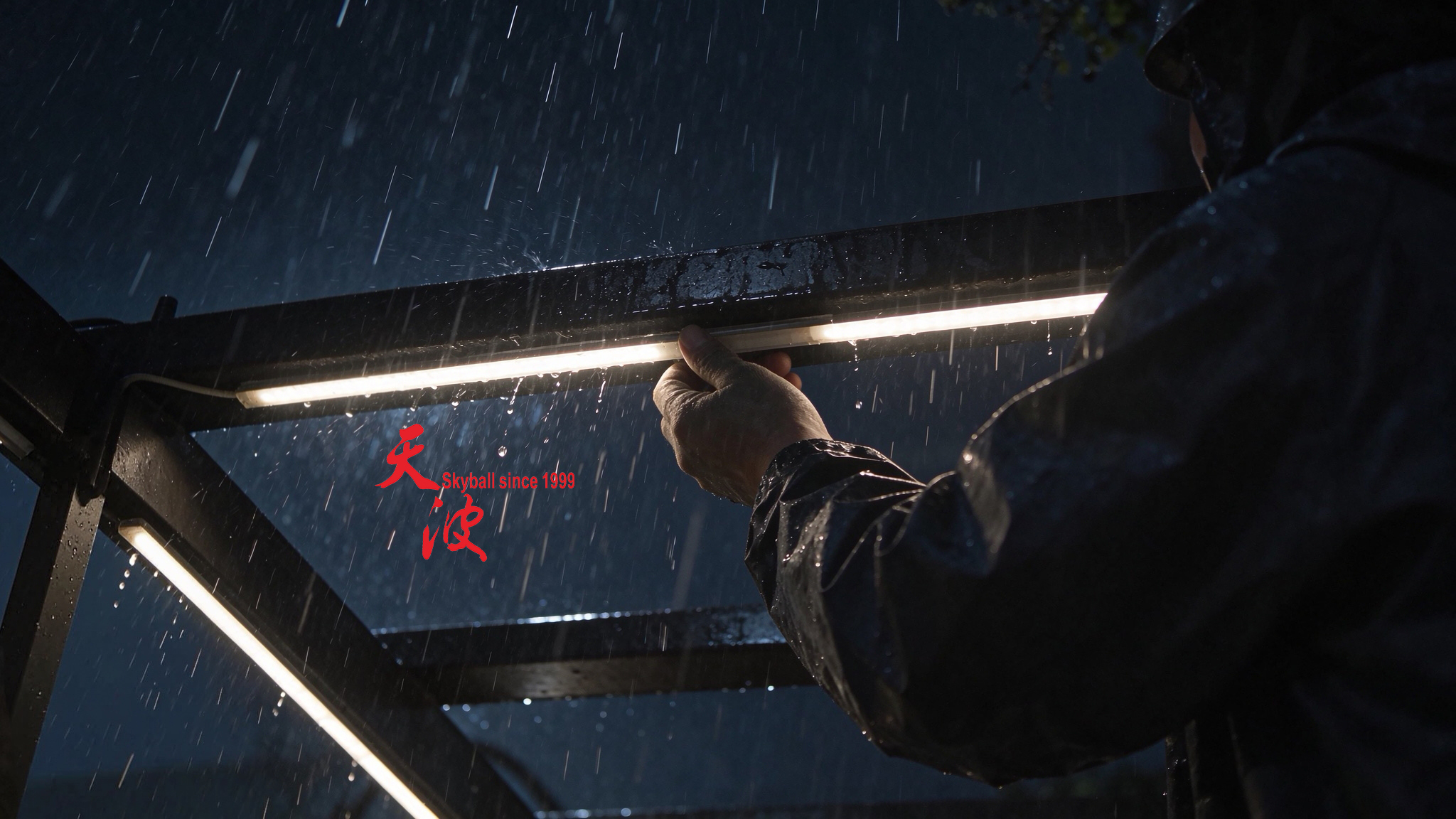
If you have ever specified lighting for an outdoor project, you have probably run into the same problem. The strip lights up perfectly on day one, but after a few rain cycles or a wet season, sections start to flicker, fail, or turn yellow. On inspection, the diodes are fine — the sealing has failed.
Waterproofing is too often reduced to an IP label printed on a strip that was simply sleeved or dipped after manufacture. But in damp, rain-exposed, or submerged environments, what determines service life is not the number on the label. It is the encapsulation process itself.
At the recent Hong Kong International Lighting Fair, SKYBALL introduced a six-grade waterproof IP matrix of roll-to-roll FCOB linear strips — from bare IP20 boards all the way to an IP68 pool-rated strip built for continuous submersion. Each grade is produced with its own encapsulation process rather than a thicker layer of the same silicone. In this first part, we cover the structural problem behind waterproofing, the three engineering challenges, and the six-grade standard. In Part 2, we explain how SKYBALL is able to build all six in-house.
Why Waterproofing Is More Than an IP Label
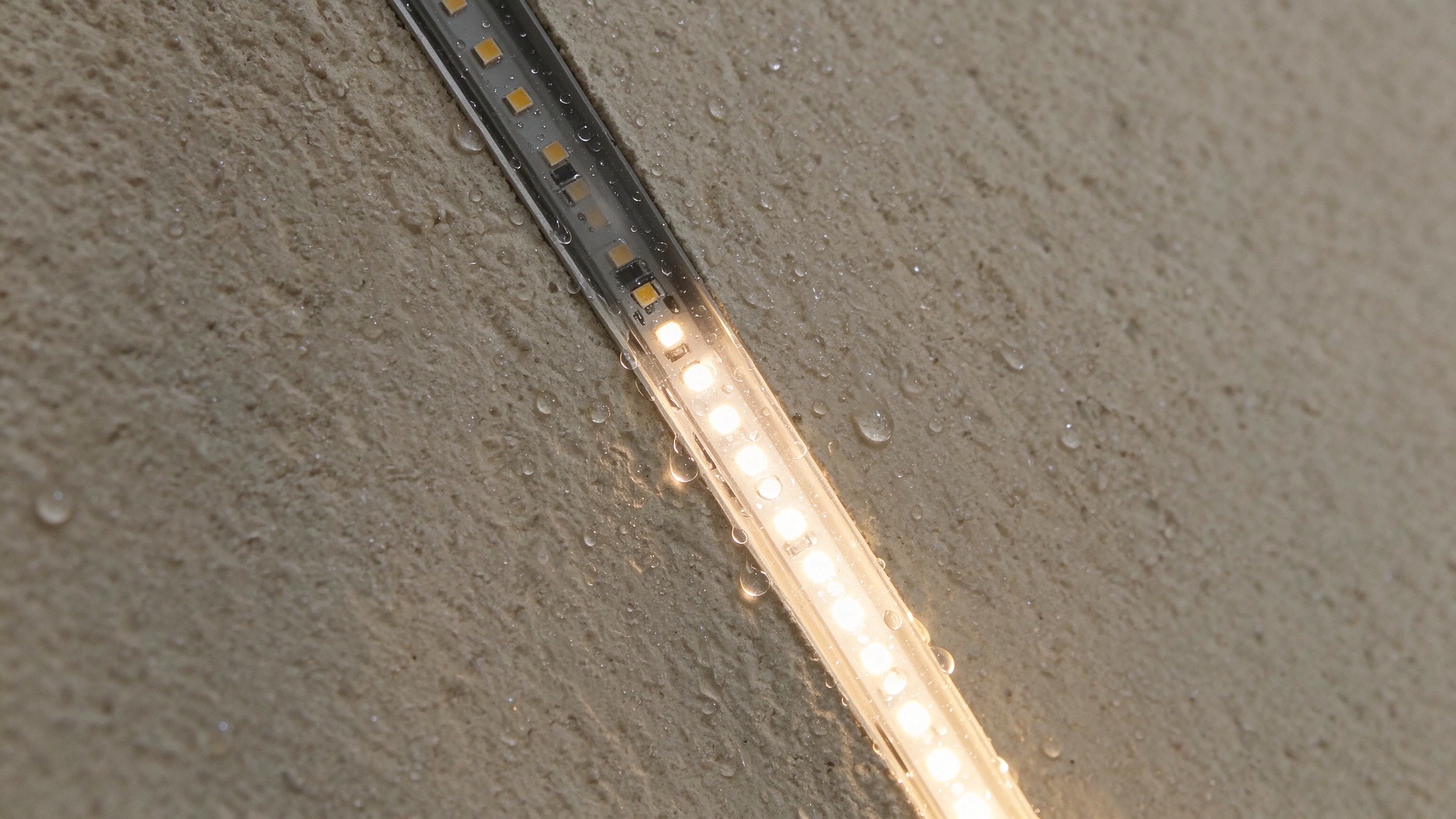
Over long periods in humid conditions, moisture travels through microscopic gaps along the strip surface, causing capillary infiltration, yellowing, and diode corrosion until entire sections fail. But before the technical details, it is worth understanding a structural problem that has persisted across the industry.
The vast majority of COB strip manufacturers do not operate their own downstream waterproofing capability. Products that need sealing are mostly sent out for external processing. Meanwhile, the downstream specialists that offer dispensing, potting, and extrusion often lack a deep understanding of the strip itself.
One side understands the light but not the sealing; the other understands sealing but not the light. Waterproofing requires both. When the two stages are split across different factories and workshops, the problems surface in some very specific engineering areas.
Three Engineering Challenges You Cannot Avoid
Waterproofing a strip is not simply adding a layer to a finished product. The encapsulation process itself changes the light output and tests the physical tolerance of the hardware.
1. Color temperature shift
The color temperature measured on a bare diode often shifts after dispensing or potting. The refractive index, thickness, and curing behavior of the compound all affect the final output. If the encapsulation team does not understand the optical characteristics of the diodes, it is difficult to hold the finished color temperature precisely on target, and a single batch can end up inconsistent.
2. Heat stress on components
Both PVC and silicone extrusion involve high temperatures during forming. Without a clear grasp of the thermal limits of the resistors, chips, and driver components on the strip, the thermal shock of extrusion can cause hidden damage. The strip lights up correctly now, but fails prematurely over time.
3. The demands on PCB ductility
During extrusion and bending, the board is subjected to continuous stretching and flexing. The copper structure and substrate toughness must be matched to the waterproofing process. The wrong board leads to open circuits and arching after processing, and the flexibility of a so-called flexible strip is lost.
None of these three problems can be solved by the strip maker or the encapsulation specialist alone. They require optical, electronic, material, and process engineering to be considered together on a single production line.
The 6-Level Waterproof IP Matrix
SKYBALL's approach is to treat waterproofing as a graded system, so that every environment has a matching process and material rather than one compound applied everywhere.
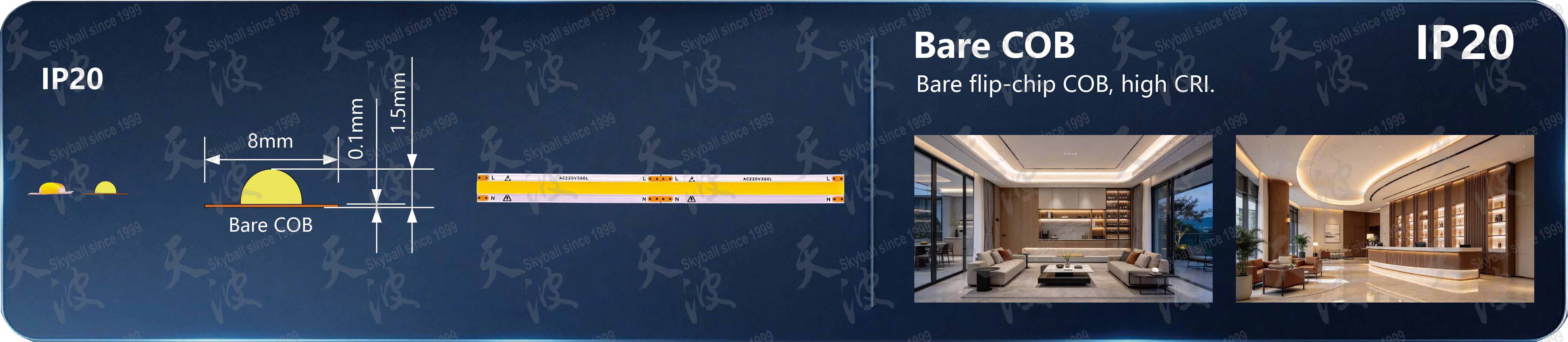
IP20 Bare Flip COB — no coating, high-CRI bare chips with an even, dot-free beam. For high-end hotel and residential indoor lighting without visible fixtures.
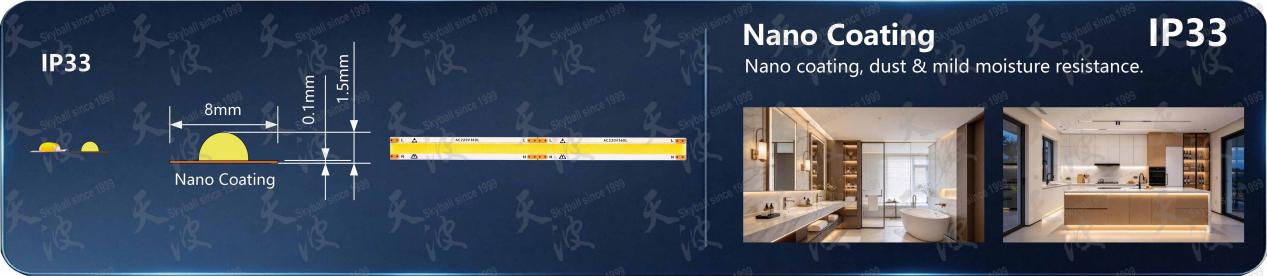
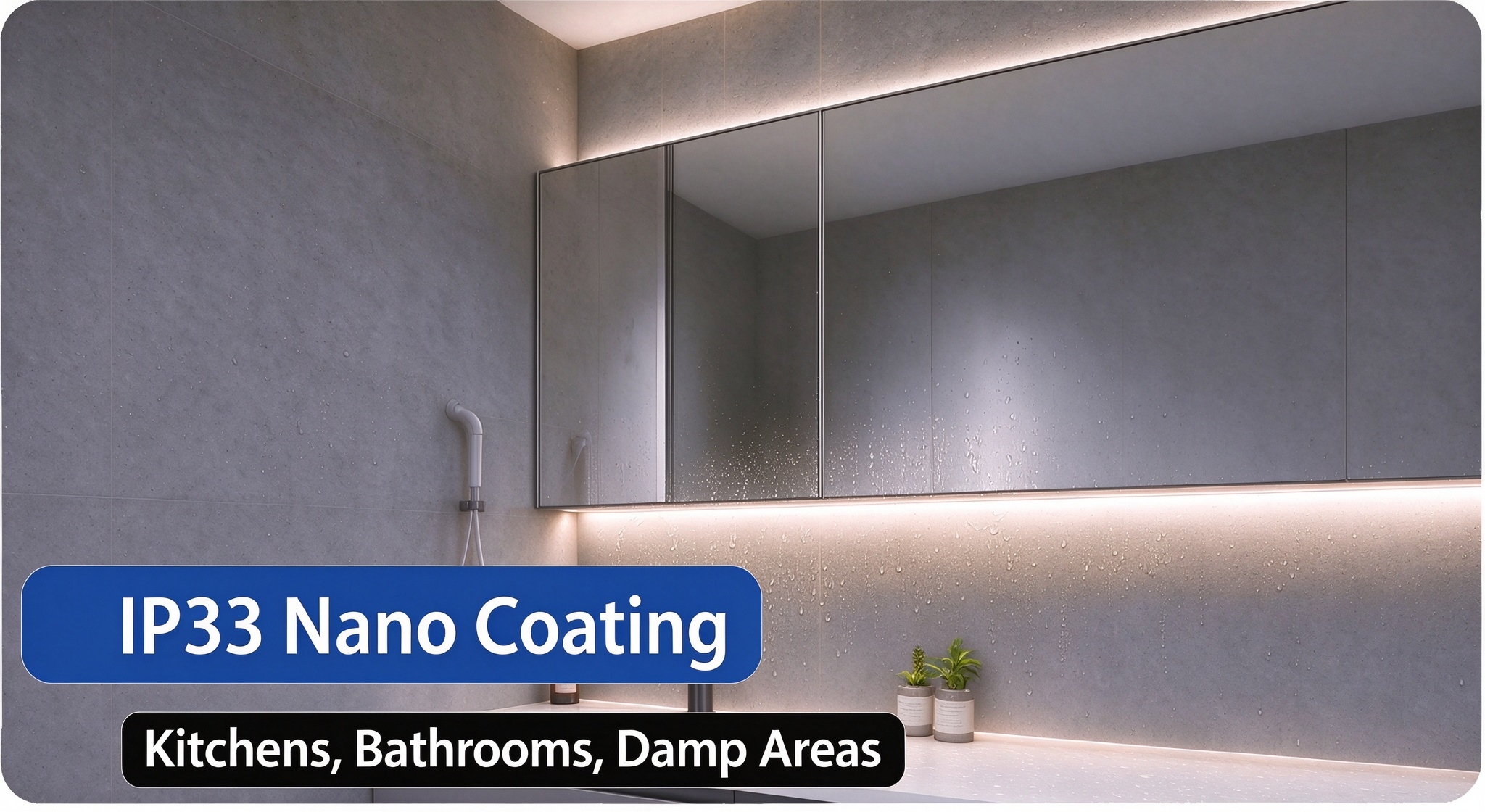
IP33 Nano Coating — nano-level conformal protection against dust and light moisture, with a thin coating and minimal light loss. For bathroom mirrors and kitchens.
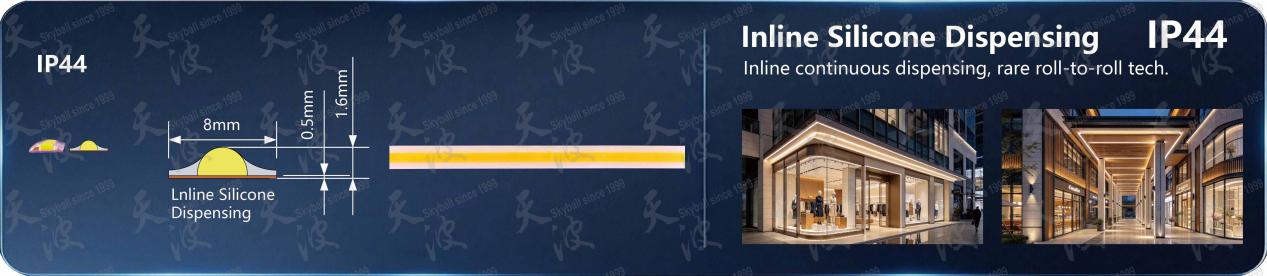
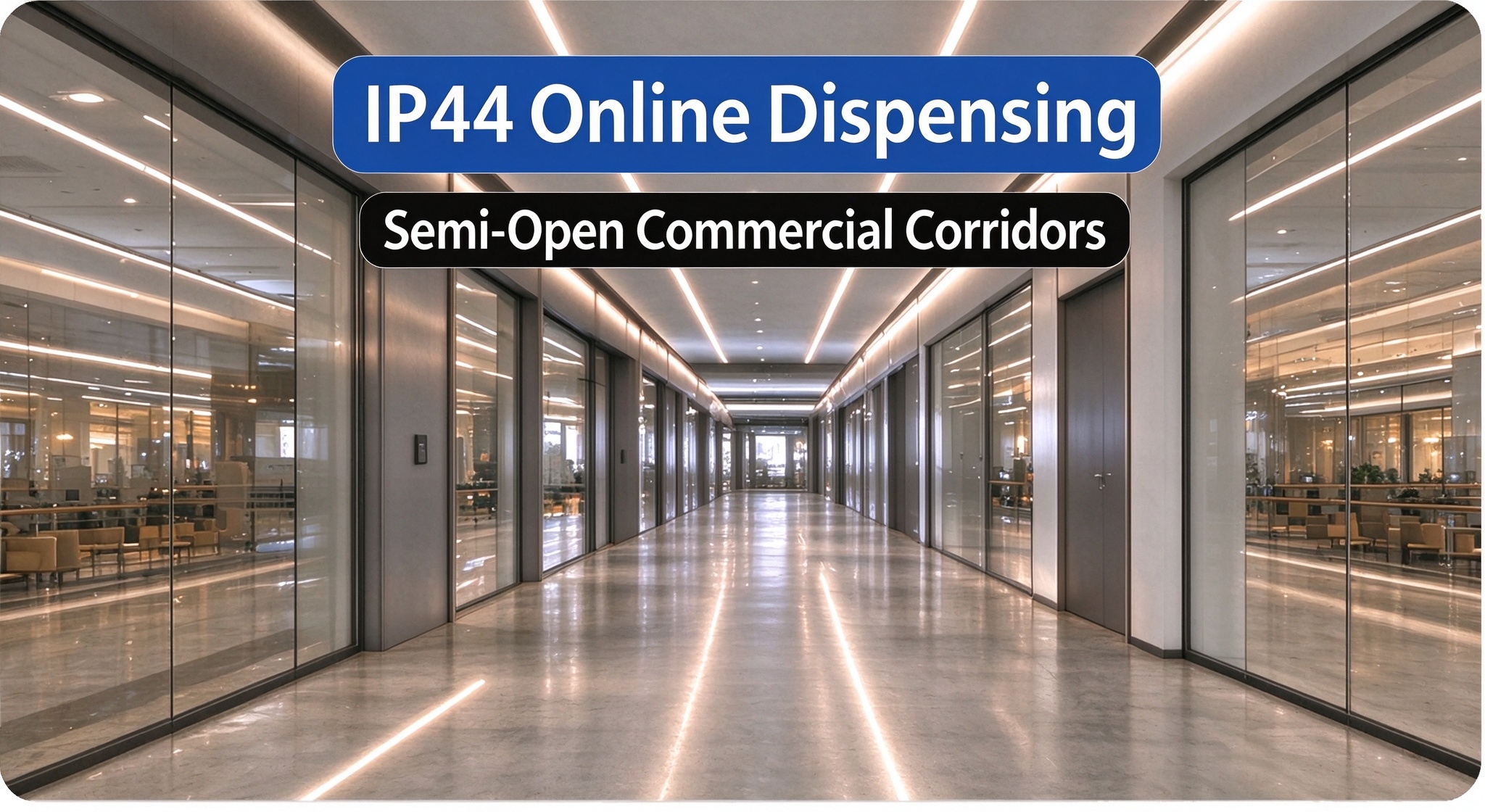
IP44 Inline Silicone Dispensing — an uncommon roll-to-roll continuous dispensing process, where silicone is applied directly on the FCOB line without secondary assembly. For commercial corridors and semi-open spaces.
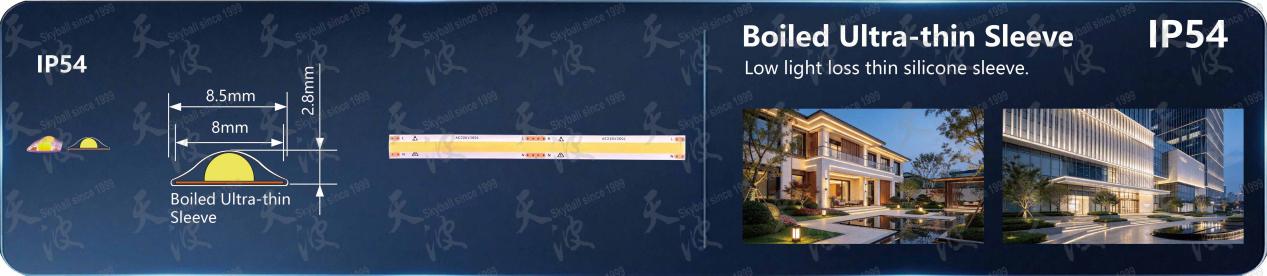
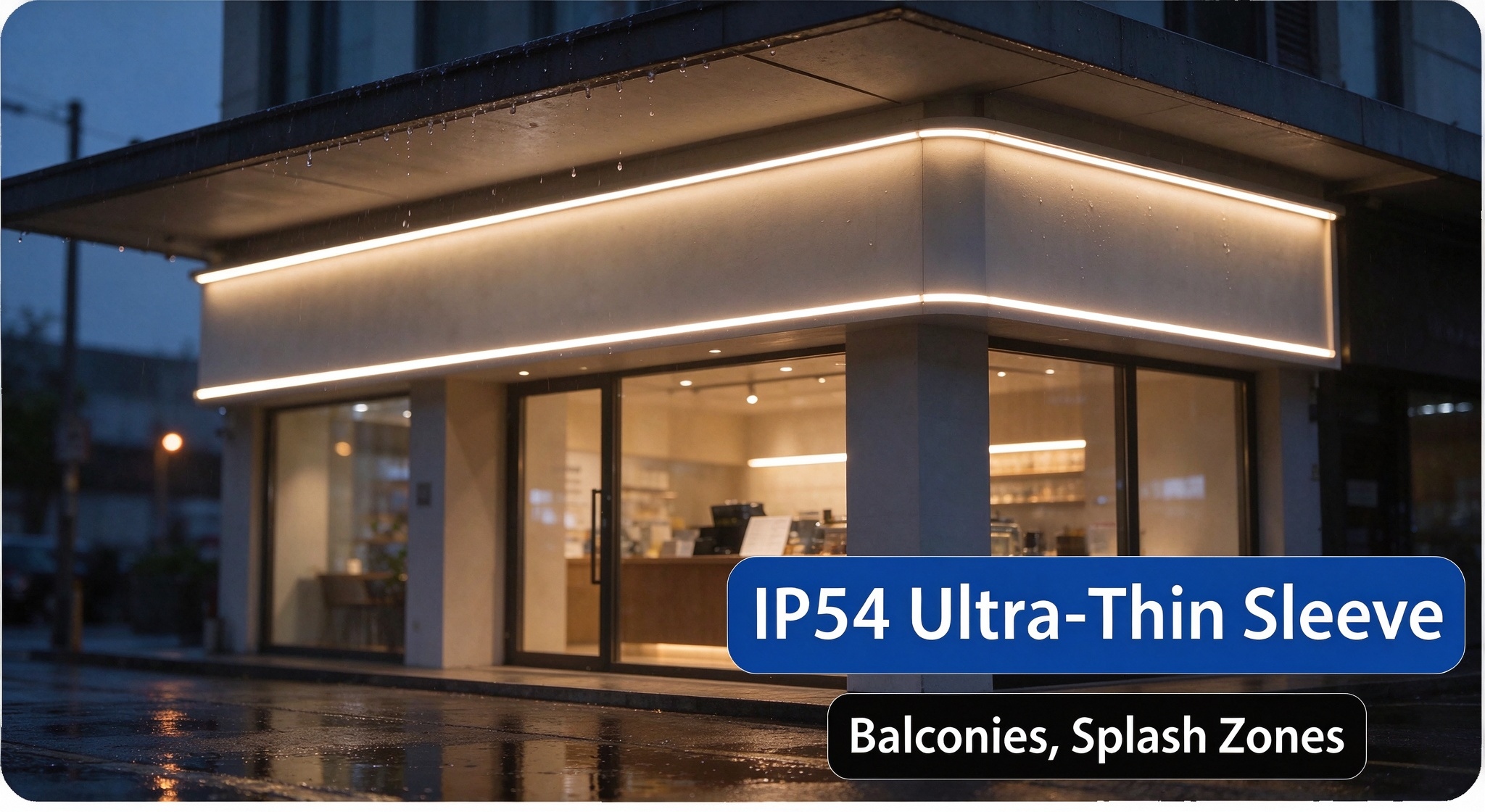
IP54 Ultra-Thin Heat-Shrink Sleeve — a low-loss, thin silicone sleeve heat-treated for a close fit, balancing flexibility and splash protection. For villa balconies and splash zones.
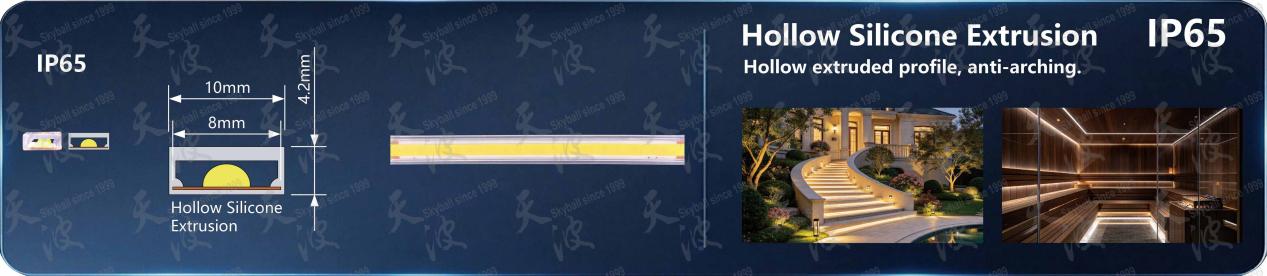
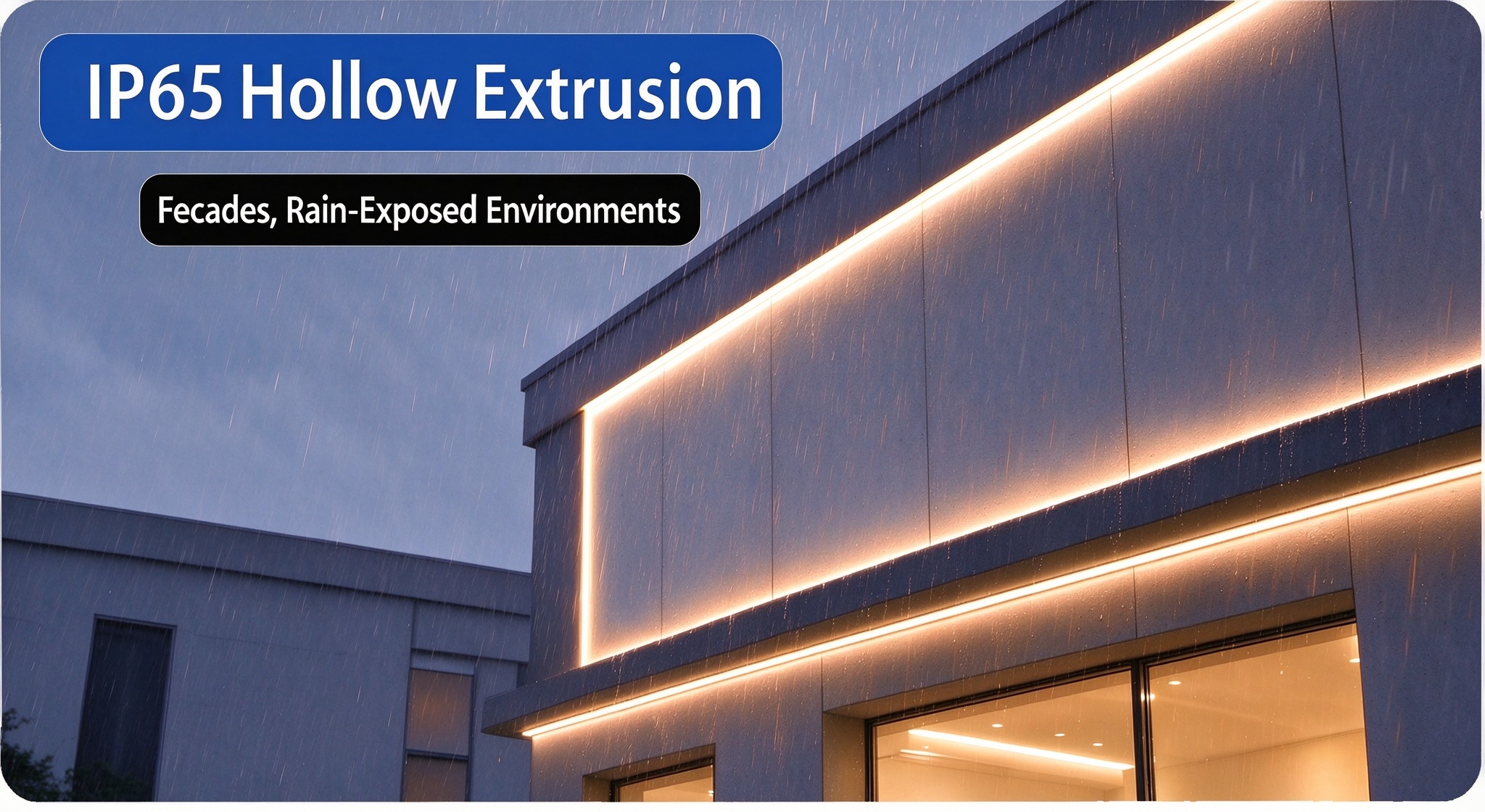
IP65 Hollow Silicone Extrusion — a hollow extruded silicone profile that resists arching under long-term bending, protecting against rain and jets. For outdoor steps and architectural outlines.
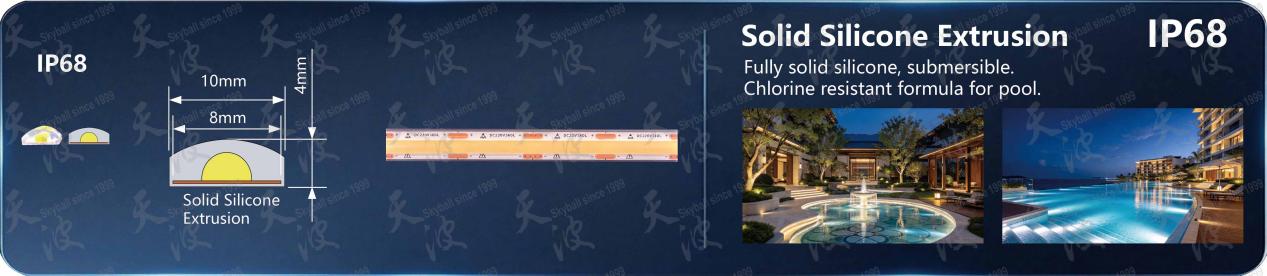
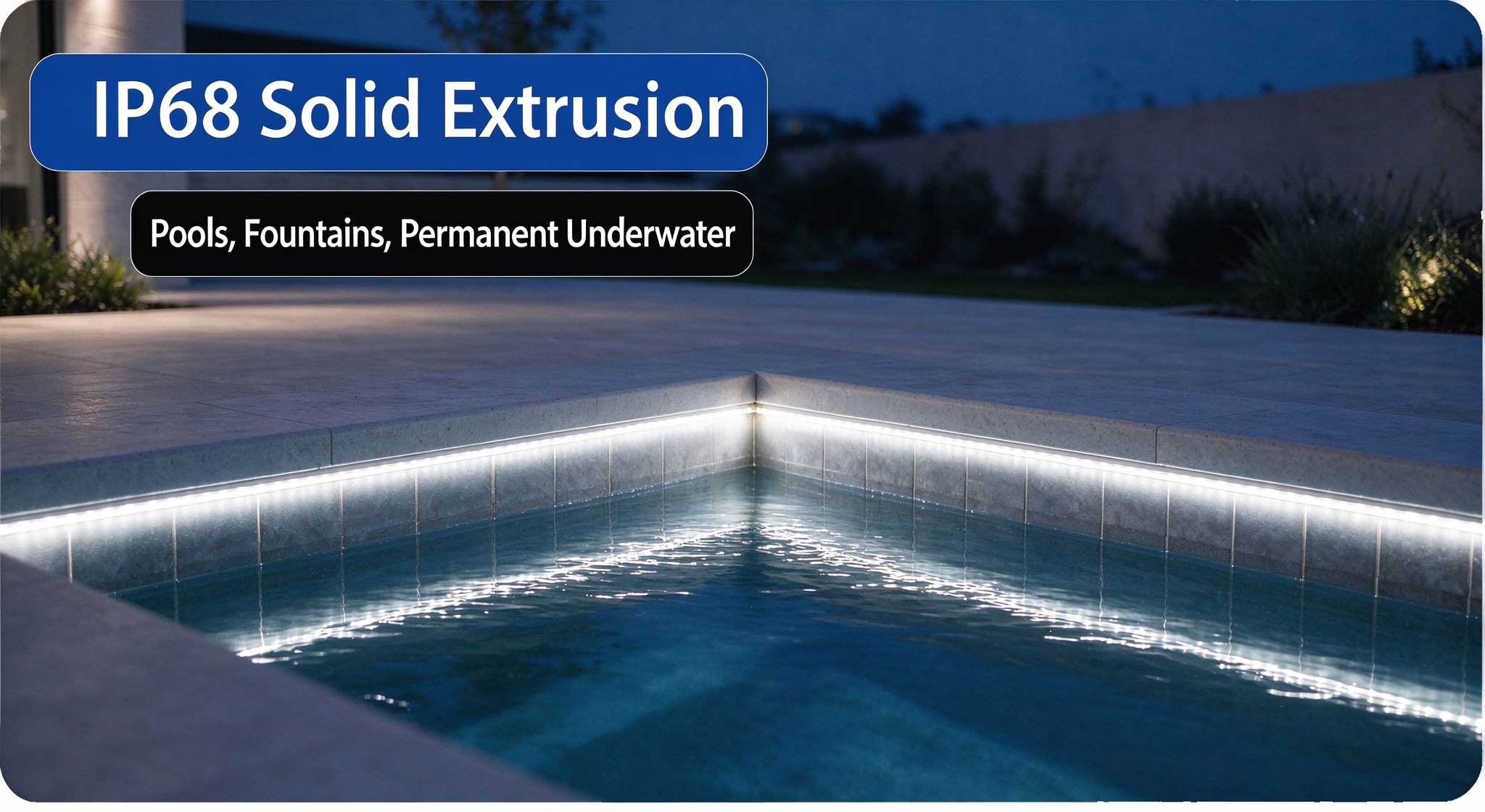
IP68 Solid Silicone Extrusion — fully solid marine-grade silicone encapsulation with a chlorine- and UV-resistant formula, rated for continuous submersion. The dedicated grade for pools and fountains.
How to Choose the Right IP Rating
For designers and contractors, selection can be mapped directly to the application:
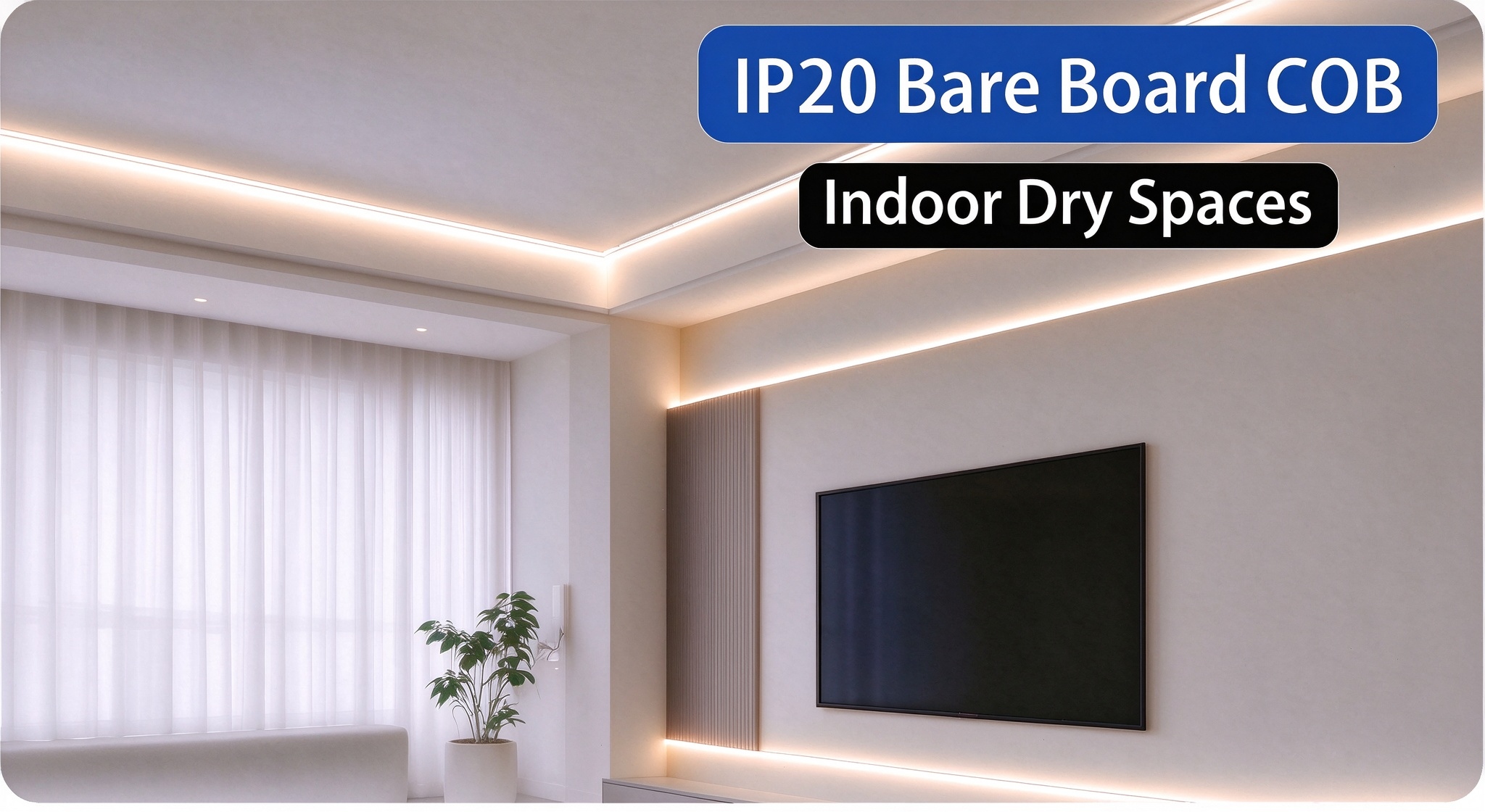
Indoor dry spaces: IP20 bare COB
Bathrooms and light-moisture areas: IP33 nano coating
Semi-open commercial corridors: IP44 inline dispensing
Balconies and splash zones: IP54 ultra-thin sleeve
Outdoor facades and rain exposure: IP65 hollow extrusion
Pools, fountains, and permanent underwater use: IP68 solid extrusion
Waterproofing is never just a label. It is a process system matched to the project environment. The value of the six-grade matrix is that lighting designers can address indoor, damp, outdoor, and underwater needs on a single COB platform with the appropriate process grade — rather than stitching together multiple suppliers.
Frequently Asked Questions
What is the difference between IP65 and IP68 LED strips?
IP65 uses hollow silicone extrusion and protects against rain and water jets, while IP68 uses fully solid silicone encapsulation and is rated for continuous submersion, typically in pools and fountains. IP68 also requires engineered end sealing to stop capillary water ingress.
Does silicone encapsulation change the color temperature?
It can. Dispensing and potting may shift color temperature depending on the compound's refractive index, thickness, and curing. This is why SKYBALL controls optical and encapsulation engineering on the same production line.
Is a higher IP rating always better?
No. Higher protection adds material and can affect flexibility and cost. The correct approach is to match the IP rating and process to the actual environment, which is the purpose of the six-grade matrix.
Can I get a sample for project testing?
Yes. SKYBALL provides test reports and sample reels for project validation, along with custom widths, color temperatures, RGB/RGBW, and control options. Contact our lighting engineers to arrange a sample.
This establishes the standard and the selection framework. The natural next question is why SKYBALL can hold all six processes in-house with consistent quality. In Part 2, we break down more than two decades of process development, the extrusion lines, roll-to-roll manufacturing, continuous sleeving, and the real barriers behind them.
Behind the Seal: How Waterproof COB LED Strips Are Really Made
HOT-SALE AC COB STRIP LIGHT--FREE DRIVER
