Behind the Seal: How Waterproof COB LED Strips Are Really Made
Behind the Seal: How Waterproof COB LED Strips Are Really Made
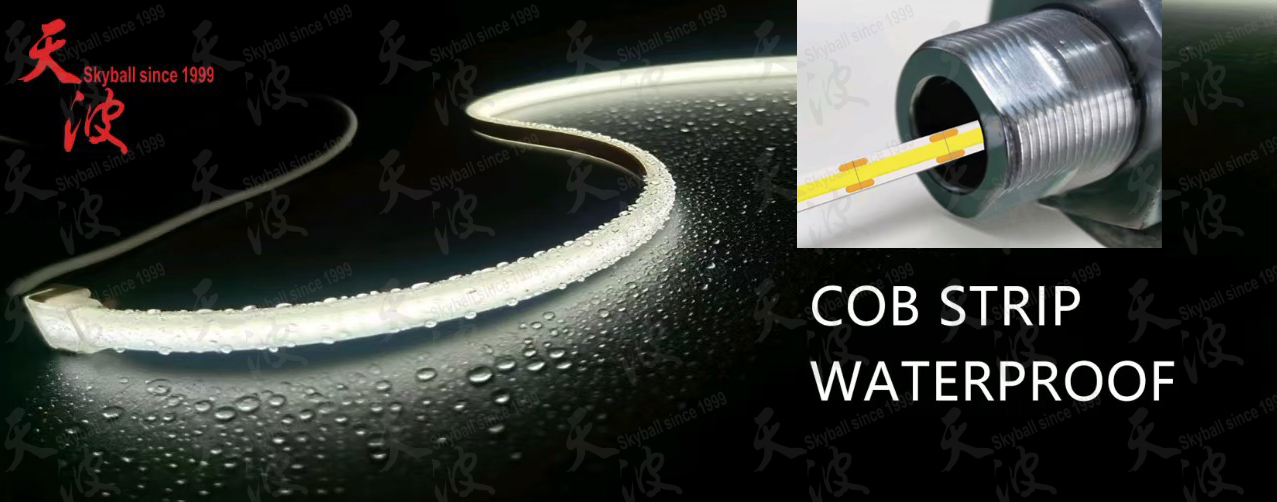
In Part 1, we explained the industry tensions behind COB strip waterproofing, the three engineering challenges, and the standard and selection logic of the six-grade IP matrix. But the more important question remains unanswered: given that waterproofing spans optical, electronic, material, and process engineering, why can SKYBALL hold all six in-house?
The answer is not a single machine. It is time. Here, we move from SKYBALL's process history through the extrusion lines, roll-to-roll manufacturing, and continuous sleeving to IP68, and take the real barriers apart.
Built on the Line Since 1999
Back in the through-hole LED era of 1999, SKYBALL was already working with PVC extrusion. What accumulated then was the most fundamental hands-on understanding of extrusion temperature and material forming.
As the industry moved into the SMD era, the process chain expanded step by step: nano coating, dispensing, potting, PVC extrusion, and silicone extrusion. Every waterproofing method was refined repeatedly on SKYBALL's own lines. For decades, the team has stayed on the production floor working on the same question — how each waterproofing process affects diode color temperature, electronic components, and the circuit board, and how to prevent those effects through process parameters in advance.
That long-term accumulation has become today's roll-to-roll integrated encapsulation. Sealing is completed continuously on the same line, flowing from chip packaging through silicone forming in one process, rather than building a bare strip and then sending it out for external processing. Each IP grade is matched to its own silicone formulation, tuned separately for UV resistance, chlorine resistance, and hydrolysis resistance. Through sleeve wall thickness and silicone transparency, the process balances sealing against light transmission, so high CRI and even output are not sacrificed by encapsulation.
Understanding the light and understanding how to seal it into material are the same capability here. This is the barrier that external processing cannot easily replicate, and the reason SKYBALL can build waterproofing across six grades.
Silicone Extrusion: Equipment, Molds, and Mastery
Of all the waterproofing processes, extrusion is SKYBALL's oldest and the clearest example of hard equipment combined with soft experience. Half of its barrier lies in the lines and molds, the other half in the people running them.
The equipment and mold base
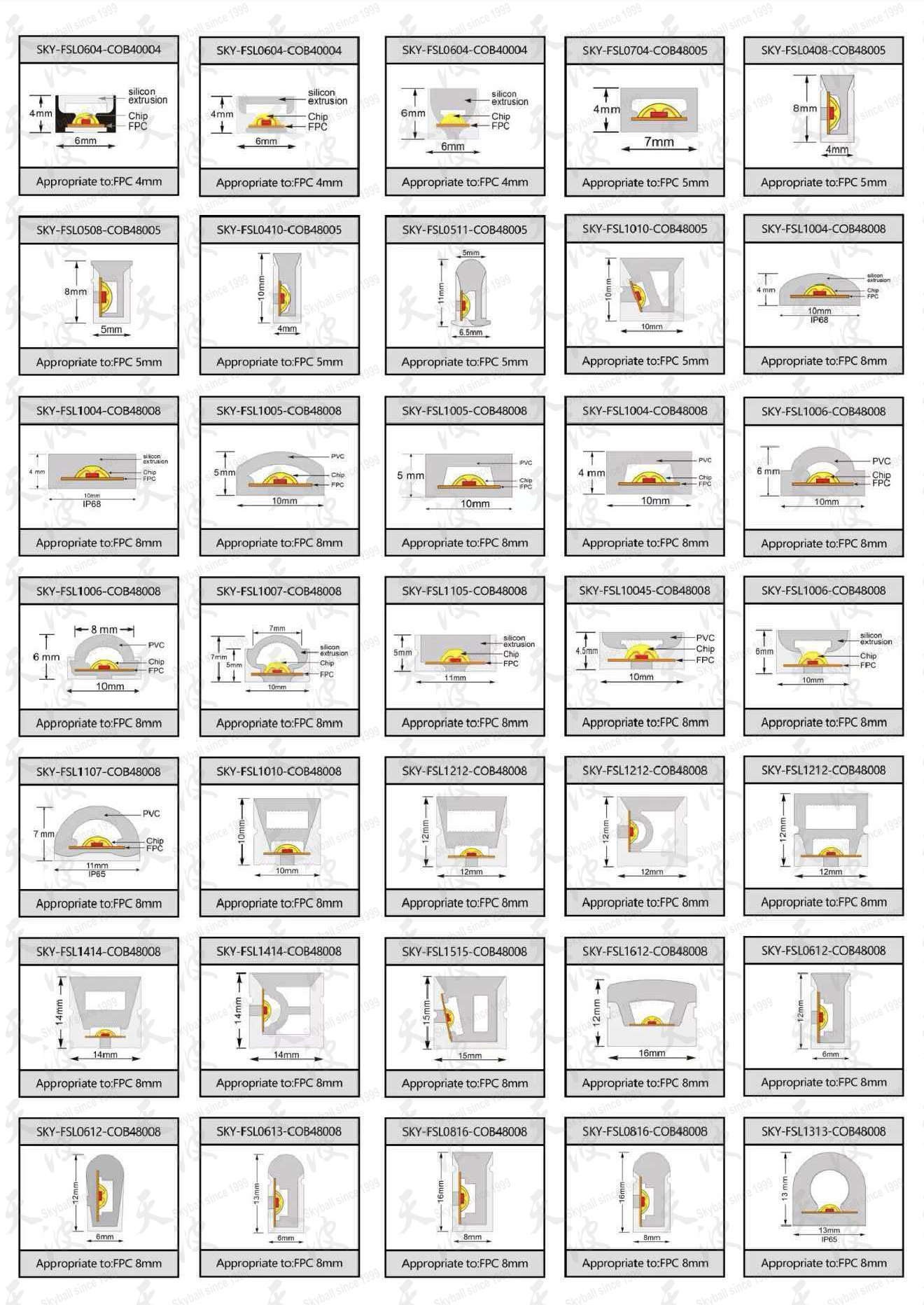
SKYBALL currently operates three silicone extrusion lines with more than one hundred matching molds, alongside seven PVC extrusion lines. Over more than twenty years, the molds opened have become difficult to count — some built to customer requirements, others developed in-house during production.
The range and depth of the mold library directly determine how many cross-sections, dimensions, and custom profiles the factory can cover, and how quickly it can respond to custom requirements. This cannot be added by simply buying equipment in the short term. It is a capability library built project by project through long service to diverse domestic and export orders.
The harder part to replicate: the operators' judgment
Across the extrusion line — from feeding the strip and loading the spools to semi-finished product testing — the positions are staffed largely by experienced operators with no fewer than five years in the industry, many of whom have spent more than twenty years on this work.
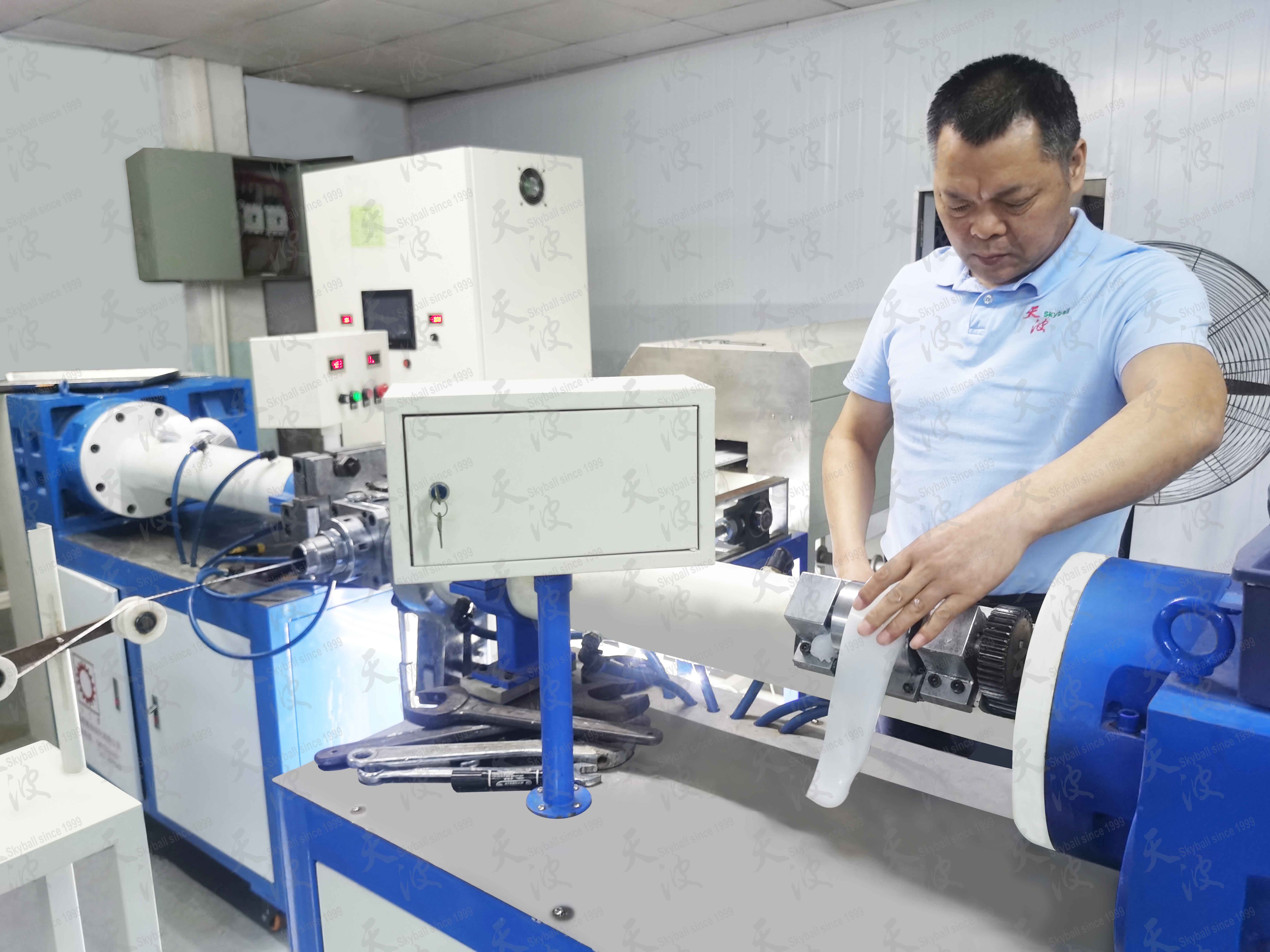
Extrusion looks like an automated machine, but it depends heavily on the operator's feel. The mixing of the compound, the adjustment of the formula, the running speed, and the control of each temperature zone have no permanent fixed parameters. Different material batches, ambient temperature and humidity, and product specifications all require careful observation and dynamic adjustment on the spot.
This answers the challenges raised in Part 1: how to hold temperature within the safe limits of the components, how to keep the formulation stable for weathering and color, and how to ensure consistency across continuous extrusion. In the end, it comes down to the master operators' repeated judgment and adjustment. Equipment can be bought and molds can be machined, but the process intuition held by people can only be built slowly through time and large volumes of real production. It is the barrier a newcomer finds hardest to cross.
Roll-to-Roll Truths: Thick Copper, Real Limits
There are two common assumptions about roll-to-roll. Clearing both up is necessary to understand the value of the process and where it applies.
Misconception one: that roll-to-roll boards are ultra-thin
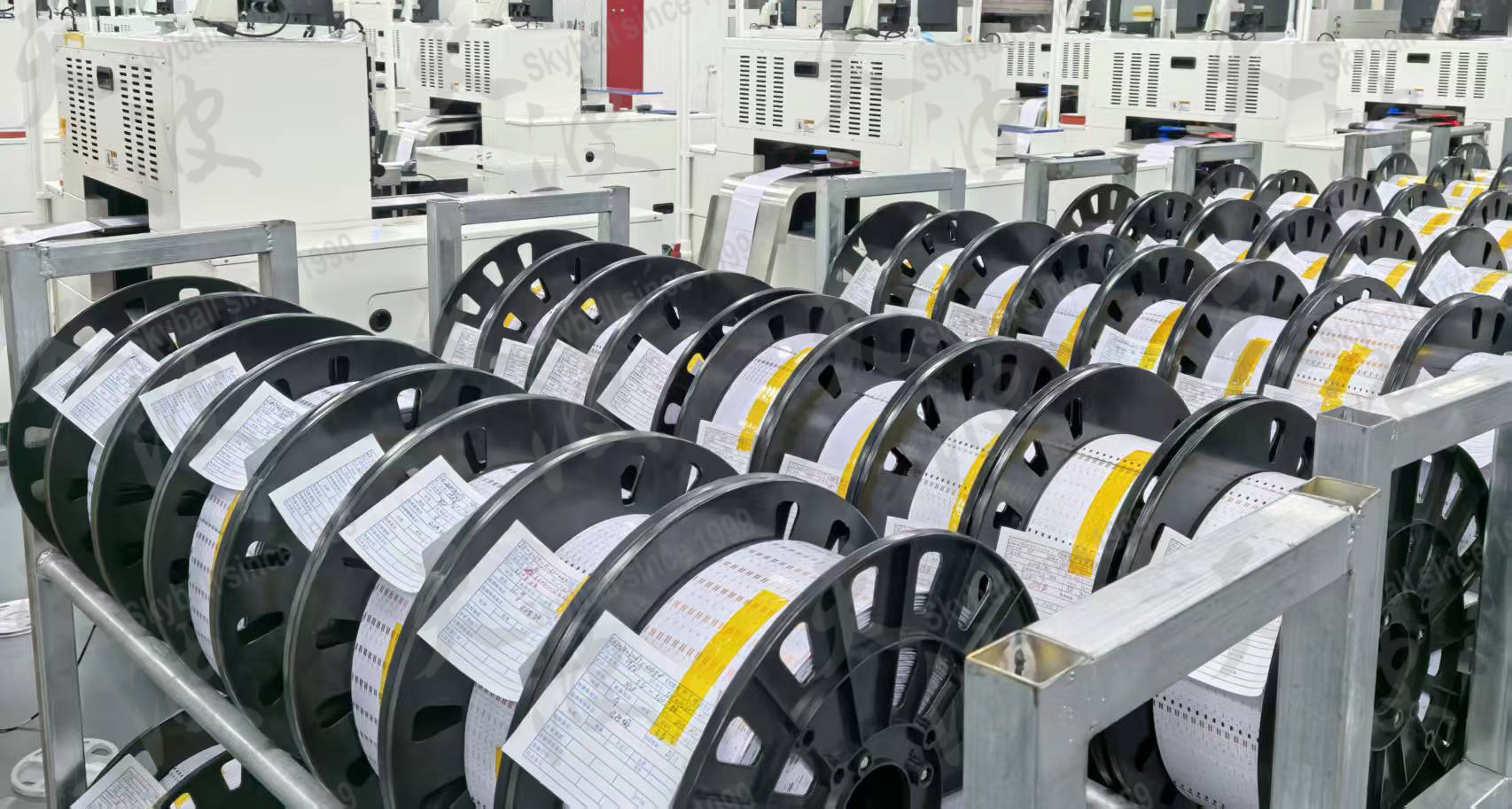
The opposite is true. Most of the roll-to-roll boards SKYBALL uses are double-sided electrolytic copper, with 2OZ and 3OZ treated simply as standard outgoing products. Thicker copper means stronger current-carrying capacity and a better thermal foundation, which is nothing like the assumption of thin, light, material-saving boards.
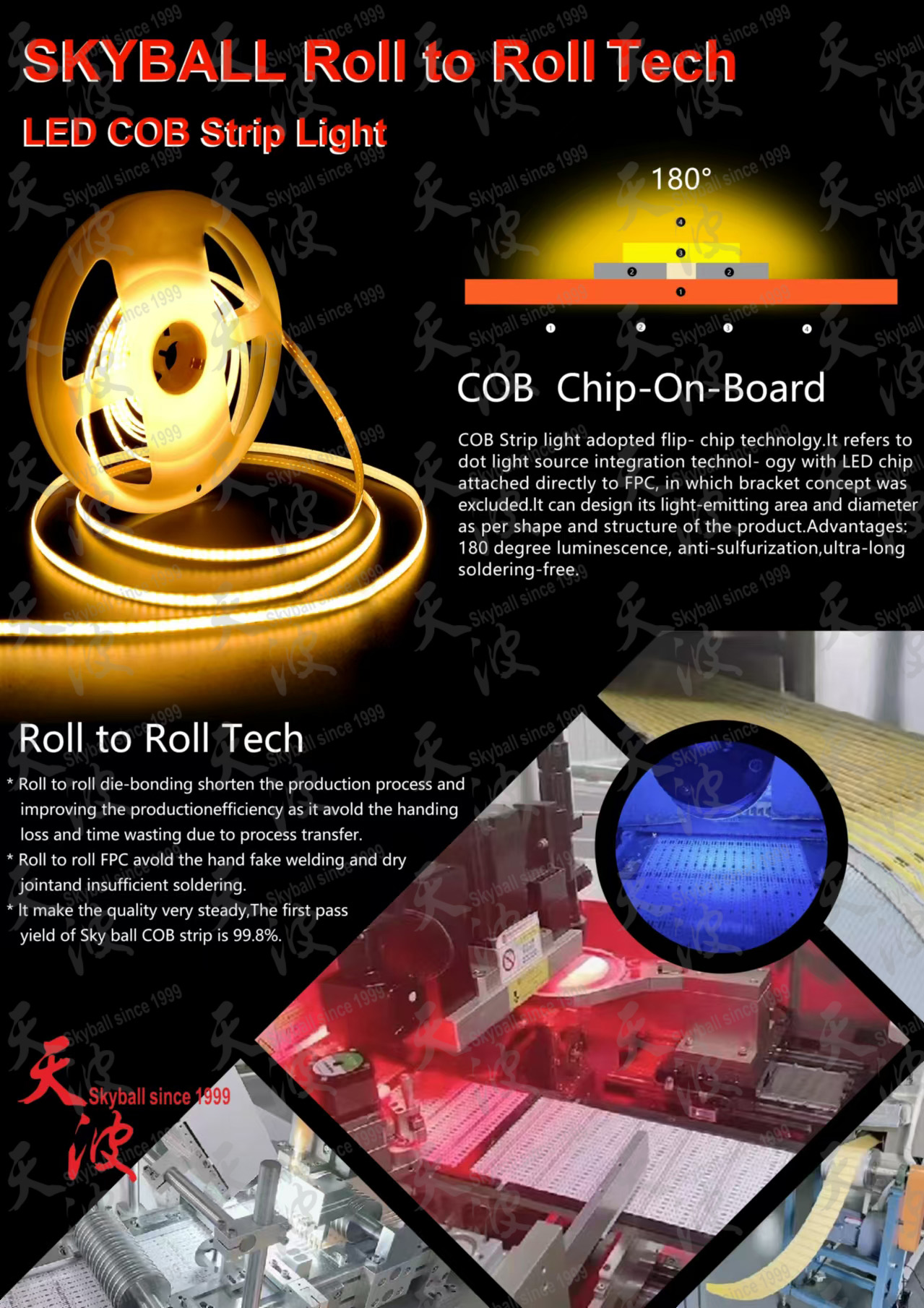
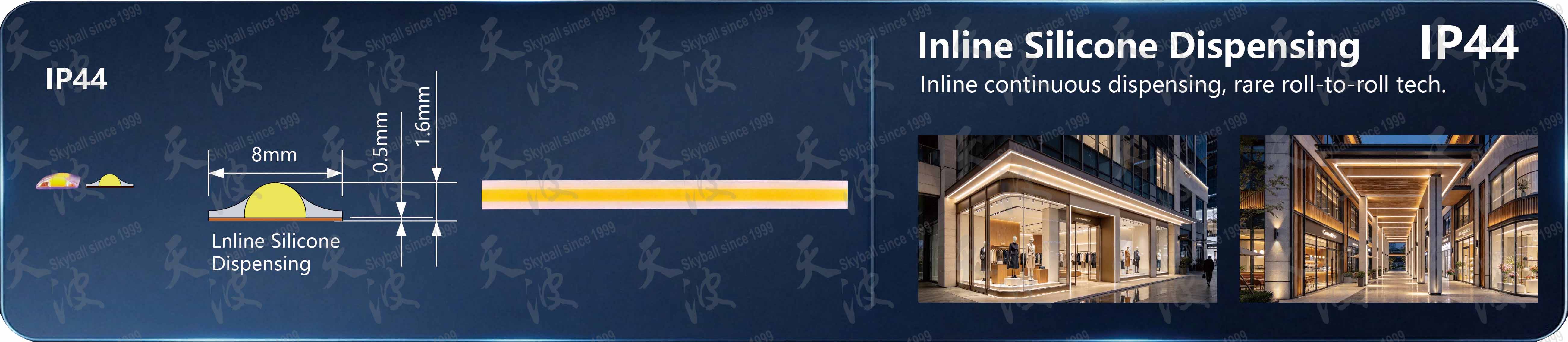
Thick copper, combined with the flip-chip structure, further improves reliability. Flip-chip die bonding places the chip in full contact with the board, shortening the thermal path for better heat dissipation and making the solder joints more secure, with excellent long-term stability. In dispensing, for example, this process is already in volume use for mirror-front backlighting. Because the roll-to-roll line runs continuously without changeover, production efficiency is high and cost is effectively controlled, resulting in strong value.
Misconception two: that roll-to-roll can take any order
Continuous Sleeving: From 5–10m to 50m and 100m
If roll-to-roll solves consistency in volume production, then in sleeving SKYBALL has crossed a threshold most competitors have not — continuous length.
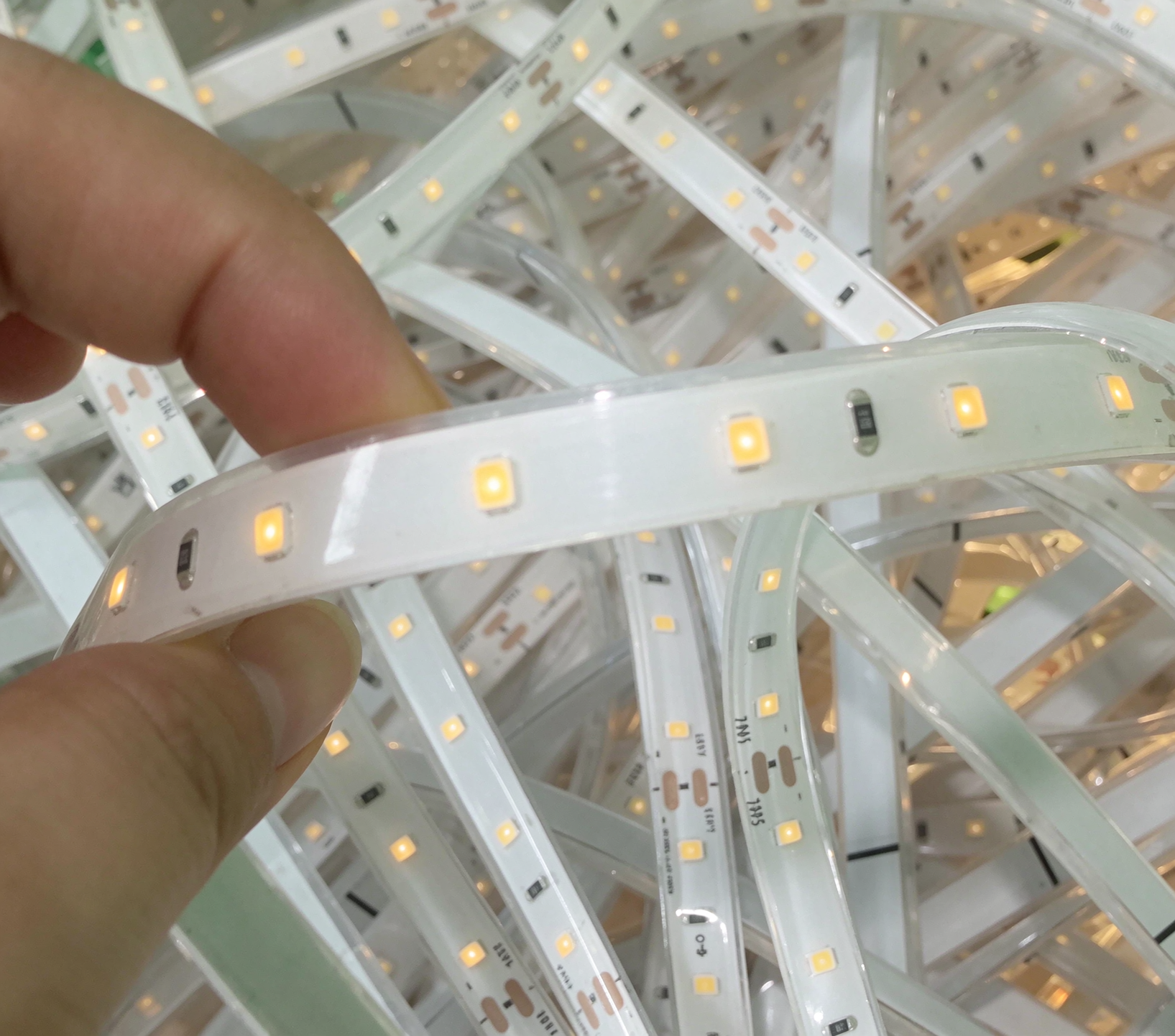
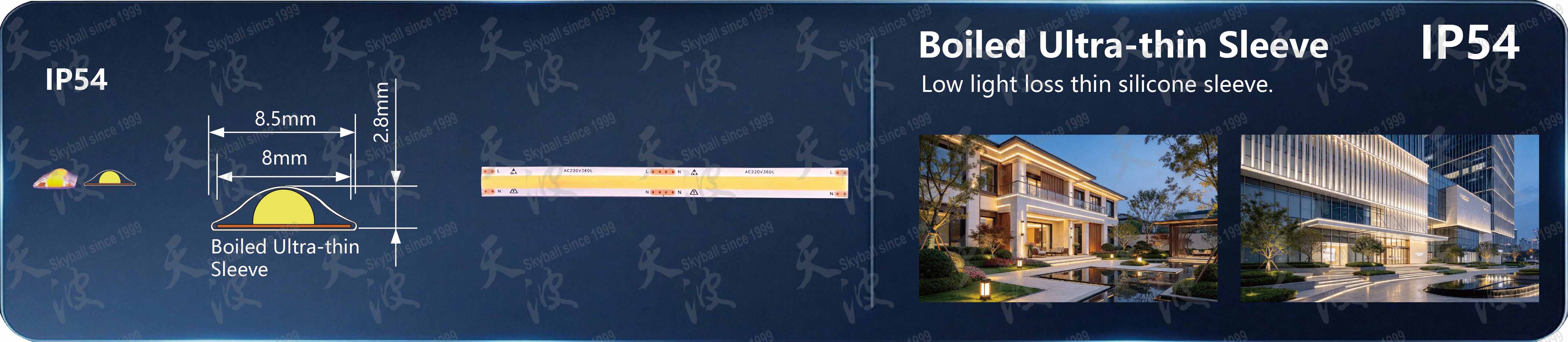
First, the optical characteristics. Unlike dispensing and potting, sleeving has little effect on the finished color temperature, so output is easier to hold consistent before and after sealing. The strip itself is light, placing little load on the mounting structure, and the boiled-sleeve process causes very little light loss, preserving original brightness and output well. This makes sleeving a cost-effective route that combines protection with optical performance.
The real difference is length. SKYBALL has achieved volume production of continuous sleeving in 50m and 100m specifications, while most manufacturers today remain limited to 5m and 10m.
The IP68 Pool Strip: The End Is the Hard Part
One fact about underwater lighting is easily overlooked: many strips marked IP68 do protect the light body, but failure occurs at the end and the connection.
Moisture travels by capillary action along the contact surface between cable and compound, and this is the leading cause of underwater strip failure. The SKYBALL IP68 pool strip uses a water-stop cable system plus triple end encapsulation to block the capillary path structurally, rather than simply printing an IP68 label on the strip.

For the pool environment, several design points matter:
- Chlorine- and UV-resistant silicone formula for long-term pool use
- Continuous submersion at up to 2m depth, with safe DC24V low voltage
- Minimum bend radius of 120mm for irregular, curved pools
- CRI above 90, compatible with DALI, DMX, Casambi, and RF control
In other words, SKYBALL delivers not a bare strip but a complete pool lighting engineering and installation solution.
Frequently Asked Questions
How long has SKYBALL been doing extrusion?
SKYBALL first worked with PVC extrusion in 1999 in the through-hole LED era, and later expanded across nano coating, dispensing, potting, PVC extrusion, and silicone extrusion in the SMD era.
What makes roll-to-roll boards reliable?
Most boards are double-sided electrolytic copper at 2OZ or 3OZ as standard, and flip-chip die bonding gives full chip-to-board contact for better heat dissipation and secure solder joints, supporting strong long-term stability.
Why does continuous sleeving matter for projects?
Continuous 50m and 100m sleeving reduces intermediate joints, which lowers the risk of breakpoints, water ingress, and contact failure and improves whole-line consistency across long architectural and landscape runs.
Where does an IP68 strip usually fail?
Often at the end and connection rather than the light body, through capillary infiltration. The SKYBALL IP68 strip addresses this with a water-stop cable system and triple end encapsulation.
From PVC extrusion in 1999 to today's roll-to-roll integrated encapsulation, continuous sleeving, and system-level IP68 sealing, SKYBALL's barrier has never been a slogan. It is equipment, molds, formulations, and the experience of generations of operators, refined repeatedly over more than two decades.
As a source factory established in 1999, SKYBALL supports customization of width, color temperature, RGB/RGBW, smart control, and project-specific silicone formulations, and provides test reports and sample reels for project validation. For technical parameters or selection help, leave a message or contact our lighting technical engineer.
tech@ledssky.com
COB LED Strip IP Ratings Explained: A 6-Level Waterproof Guide